


Beyond the Label - Supporting Neurodivergent Students Through IEPs vs. 504s in 2026

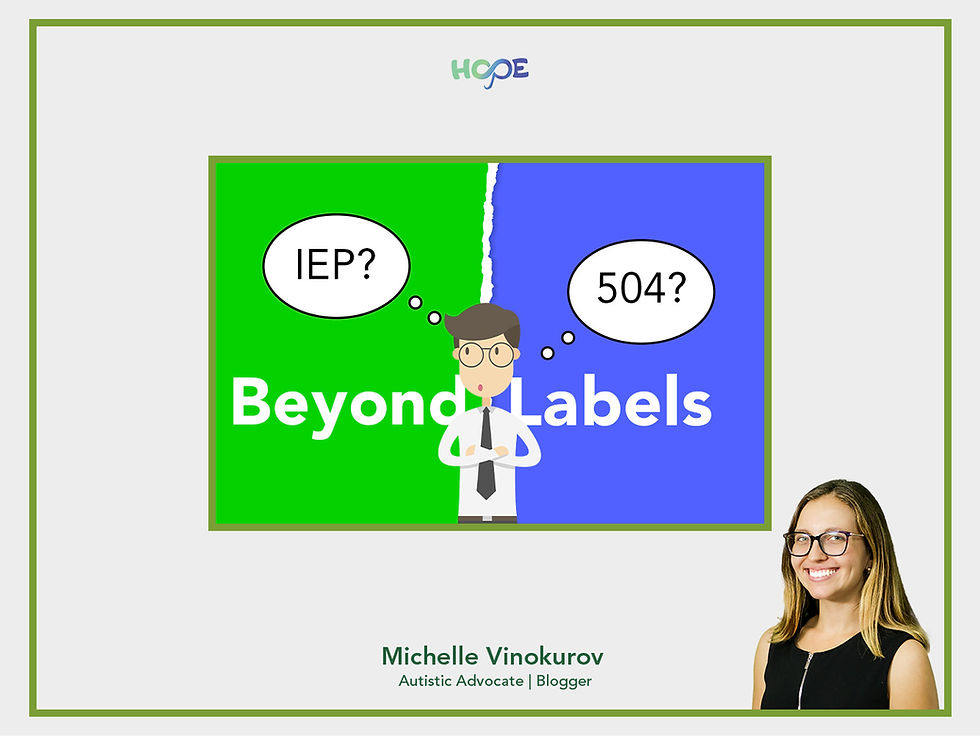
For families of neurodivergent students, hearing terms like IEP and 504 Plan can sometimes bring a mix of questions and emotions. There may be meetings, paperwork, accommodations, goals, and conversations about what a child needs at school. It can all feel like a lot to take in, especially when you are simply trying to make sure your child feels supported and understood.
But behind every IEP or 504 Plan is a student with a personality, strengths, challenges, interests, and dreams. That is why understanding these plans should go beyond the label. The paperwork matters, but the person behind it matters just as much.
A Personal Connection to IEPs
I can relate to this topic because I grew up with an IEP. My parents were involved in my education and helped advocate for the support I needed. As I got older, I became more involved in my own IEP meetings, beginning in middle school, which I also shared in my previous blog.
Being involved helped me gradually understand that I had a voice in my education. It was an important part of growing up and becoming more aware of what helped me learn and succeed.
My experience is only one example, though. Every neurodivergent student's educational journey can look very different, which is why it is so important to look beyond a diagnosis or a particular type of plan.
Understanding IEPs and 504s
An IEP and a 504 Plan can provide different types of support. An IEP may include individualized goals, specialized instruction, and other services based on a student's educational needs. A 504 Plan may focus on accommodations and supports that help a student access and participate in their education.
The important thing for families is not simply memorizing the differences between the two. It is understanding what those differences mean for their individual child.
There is no single formula for supporting every neurodivergent student.
One student may need extensive support throughout the school day, while another may need specific accommodations that help with organization, attention, sensory needs, communication, or other challenges. Going beyond the label means asking what this particular student needs rather than assuming that every student with the same diagnosis will need the same support.
Looking Beyond the Paperwork
It can be easy for educational meetings to become focused on paperwork and requirements. But once the meeting ends, the student still has to walk into the classroom and navigate their day.
That is where the human side of support becomes so important.
Teachers and professionals may notice things that do not always appear on a document. Perhaps a student becomes overwhelmed when the classroom is noisy, needs extra time to process information, struggles when routines suddenly change, or becomes more successful when directions are presented differently.
Those observations can help everyone understand the student more fully.
Looking beyond the paperwork means continuing to learn about the student instead of treating the IEP or 504 as the end of the conversation.
Families Know Their Children
Parents and caregivers bring an important perspective to educational planning because they know their children outside of school. They may understand what helps their child transition between activities, communicate when overwhelmed, or regain confidence after a difficult experience.
Teachers and school professionals see another side of the student. They see classroom participation, academic work, social interactions, routines, and day-to-day progress.
Neither perspective has to replace the other.
When families and professionals work together, they can create a fuller picture of the student. That collaboration allows everyone to look beyond the label and focus on the person.
Students Deserve a Voice
As neurodivergent students grow older, their own voices become increasingly important.
My experience of becoming involved in my IEP meetings during middle school showed me how meaningful it can be for students to have a place in conversations about their education. Students can gradually learn to recognize their strengths, understand what challenges them, and communicate what kinds of support are helpful.
That does not mean every student will participate in the same way. It simply means that, when appropriate, students should have opportunities to be heard.
Sometimes self-advocacy begins with something very simple: being able to say, "This helps me learn."
Supporting the Whole Student
Teachers, therapists, administrators, and other professionals have many responsibilities, and educational plans can provide an important roadmap. But the student should never become invisible behind the document.
Take time to learn what the student enjoys. Notice their accomplishments. Celebrate progress that may not always show up in grades. Pay attention when something seems difficult, and remain open to trying a different approach.
Most importantly, remember that a student's needs can change.
A support that made a difference before may not be what a student needs today. A support that was once necessary may eventually become less important, while a new challenge may require additional help.
Going beyond the label means remaining willing to see the student as they are today, not simply as they were when a plan was first created.
The Person Behind the Plan
An IEP or 504 Plan can be an important part of a neurodivergent student's educational experience, but it cannot tell their entire story.
A student is more than a diagnosis. They are more than their accommodations. They are more than the areas where they need help.
They are also their interests, accomplishments, personality, relationships, creativity, goals, and potential.
That is something families and professionals can carry into every meeting and every classroom interaction.
Conclusion: Seeing Beyond the Label
My own experience growing up with an IEP taught me that educational support can become part of a student's journey toward understanding themselves and finding their voice. Being involved in my IEP meetings beginning in middle school was one part of that process.
But every student's journey will look different.
Whether a student has an IEP, a 504 Plan, or another form of support, the most important thing is remembering the person behind the plan.
Look beyond the diagnosis.
Look beyond the paperwork.
Look beyond what a student may struggle with.
There is so much more to discover when we take the time to see the whole person.
If you enjoyed this blog story, check out more great content in the following links:


Comments